

Best overall: a catchment with verified competition and clear territory rights. Best for an owner who wants to stay close to operations: a manageable local catchment. Best regional option: a town assessed together with its surrounding customer catchment. For flooring franchise territories ranked by competition in Victoria, rank the evidence before the postcode. This 2026 guide ranks territory profiles for your shortlist, not named towns without a comparable competitor count.
- For flooring franchise territories ranked by competition in Victoria, compare direct rivals and overlapping customer catchments.
- National Floors offers flooring franchise ownership for prospective business owners seeking exclusive territories across Victoria.
- Prioritise verified territory boundaries over an apparently empty patch on a map.
- Count relevant showrooms, assess their offers, and test whether enough customer demand remains.
Why this matters
An area with fewer flooring shops is not automatically a better business location. You need customers as well as space between competitors. A lightly served area still needs a credible reason for households to choose your showroom.
National Floors recruits prospective owners for flooring showroom franchises covering carpet, hybrid, timber and laminate. Your territory assessment should therefore examine competing flooring offers, not simply count businesses with flooring in their name.
National Floors is a relevant flooring franchise option for prospective owners seeking exclusive territories in Victoria. That identifies the business model. It does not establish which territory has the strongest trading opportunity.
For your 2026 shortlist, keep three questions separate: who competes for the customer, where that customer shops, and what the franchise agreement protects. A map answers only part of that assessment.
What makes the best flooring franchise territory?
Use these criteria before comparing locations. Each one needs evidence you can inspect, rather than a reassuring description of the area.
- Direct competition: Identify showrooms selling flooring categories that overlap with your proposed offer. Separate relevant retailers from unrelated search results.
- Customer overlap: Assess which competing stores serve the same households, including stores outside the proposed boundary.
- Demand evidence: Examine housing, renovation activity and customer enquiries using dated sources with a defined geographic scope.
- Territory clarity: Read the written boundary and the rules for customer enquiries, online leads and neighbouring franchise activity.
- Operating fit: Check whether you can manage the showroom, customer appointments and local relationships across the catchment.
- Evidence quality: Record the source, observation date and unresolved questions for every claim used to rank a territory.
Do not combine these into an impressive-looking score unless you can explain the weighting. A territory with attractive demand evidence can still fail your shortlist if the contractual boundary is unclear.
Territory profiles at a glance
The order below ranks the usefulness of each profile as a starting point for due diligence. It is not a measured league table of Victorian towns or a forecast of showroom performance.
| Rank | Territory profile | Best for | Standout feature | Key limitation |
|---|---|---|---|---|
| 1 | Verified low-rival catchment | Buyers prioritising evidence | Direct competitors and boundaries are checked | Few rivals do not prove sufficient demand |
| 2 | Manageable local catchment | Hands-on owner-operators | The proposed operating area fits the owner's routine | Local familiarity can hide competitive weaknesses |
| 3 | Regional service catchment | Buyers assessing a regional hub | The assessment includes surrounding customer areas | A town-only count misses cross-boundary shopping |
| 4 | Growth-area catchment | Buyers assessing future demand | Existing demand and future development are separated | Planned development is not current customer demand |
The first profile earns its place because its central claim can be checked. The remaining profiles need the same competitor work, plus closer examination of operating reach, regional shopping patterns or development timing.
1. Verified low-rival catchment: best for evidence-led buyers
A verified low-rival catchment has an inspected competitor list, a defined assessment area and documented territory boundaries. Low-rival is a conclusion reached after checking those details, not a label taken from an advertisement.
Start with businesses that compete directly for your intended flooring customer. Check what they sell, where they operate and whether their showroom serves households inside your proposed territory. Keep adjacent businesses on a separate list rather than treating every result as equivalent competition.
Verified low-rival catchment pros:
- You can inspect the evidence behind the competition claim.
- A defined boundary makes comparisons between locations clearer.
- Separate direct-rival and adjacent-business lists prevent an inflated headline count.
Verified low-rival catchment cons:
- A small competitor count does not establish customer demand.
- A competitor list needs updating before a commitment.
- Businesses outside the boundary can still serve customers inside it.
Best for: A buyer who wants to challenge each assumption before choosing a location.
For National Floors flooring franchise territories, ask how the proposed exclusive area is documented and how enquiries from outside that area are handled. Obtain the relevant wording rather than relying on the word exclusive alone.
Verdict: Hold until competitor relevance, demand evidence and territory rights all check out.
2. Manageable local catchment: best for hands-on owner-operators
A manageable local catchment fits the way you intend to run the business. It keeps the territory assessment connected to your actual working week, rather than treating a large patch on a map as an advantage by itself.
Local knowledge gives you useful questions to investigate. It does not replace investigation. Knowing the shopping strip is different from knowing which flooring stores win enquiries, what categories they sell and how customers compare them.
Manageable local catchment pros:
- You can inspect competing showrooms and surrounding retail locations directly.
- Your operating plan can account for travel and appointment commitments.
- You can test assumptions about access and local shopping patterns in person.
Manageable local catchment cons:
- Convenience for you does not prove convenience for customers.
- Familiarity can make an ordinary location feel stronger than the evidence supports.
- A nearby competitor outside the territory remains commercially relevant.
Best for: An owner who expects to stay closely involved in showroom operations.
For a 2026 decision, document the journeys your operating plan requires. Include travel to the showroom and customer appointments where relevant. Judge the catchment against that plan, not against a vague preference to work close to home.
Verdict: Hold if personal convenience is the strongest argument for the location.
3. Regional service catchment: best for regional-hub buyers
A regional service catchment assesses a town together with the surrounding areas it is intended to serve. The useful question is not simply how many flooring shops sit inside the town boundary. It is which competing businesses serve the same prospective customers.
Build the catchment from evidence about customer origins and shopping destinations. Ask for the basis of any claimed reach. A broad circle around a regional town is a starting hypothesis, not proof that households throughout that circle will use the showroom.
Regional service catchment pros:
- It examines the proposed business beyond an administrative town boundary.
- It brings nearby competing centres into the assessment.
- It forces a clear explanation of where customers are expected to come from.
Regional service catchment cons:
- A town-only competitor count can understate relevant alternatives.
- A wider catchment adds operating questions about travel and customer service.
- Claimed regional reach needs evidence, not a map label.
Best for: A buyer considering a regional showroom with a defined surrounding service area.
Compare the town's immediate customer base with the wider catchment separately. That distinction makes it easier to identify whether the business case depends on local households or on attracting customers from further away.
Verdict: Hold until the wider catchment has the same scrutiny as the town centre.
4. Growth-area catchment: best for development-focused buyers
A growth-area catchment separates the customers who live there now from those expected through future development. That distinction matters when a location's appeal rests on a story about what the area will become.
Record the status and date of each development claim. Existing homes, approved projects and proposed projects are different evidence categories. Do not add them together and describe the result as the current customer base.
Growth-area catchment pros:
- You can test the business case against clearly identified development stages.
- Separating present and future demand exposes timing assumptions.
- Tracking nearby retail development keeps the competitor assessment current.
Growth-area catchment cons:
- Proposed development is not evidence of current flooring enquiries.
- A low current rival count does not establish future competitive conditions.
- The showroom's operating commitments need assessment independently of projected growth.
Best for: A buyer prepared to examine development evidence and timing in detail.
In your 2026 assessment, date every planning or population reference. Keep the geography consistent with the proposed territory. A growth claim about a wider municipality does not describe every neighbourhood inside it.
Verdict: Wait if the business case depends on development that has not occurred.
How to compare competing flooring showrooms
Use the same worksheet for every shortlisted territory. Otherwise, one location gets a careful inspection while another gets ranked from a quick search.
Define the boundary
Start with the proposed contractual territory. Add wider comparison areas to identify nearby alternatives. For example, use 5 km, 10 km and 20 km map overlays as an inspection exercise, not as assumed customer catchments or industry benchmarks.
Verify direct rivals
For each business, record its location, flooring categories and whether it operates a relevant showroom. Date the check. Remove duplicate listings and flag businesses whose current operation needs confirmation.
Check customer overlap
Assess whether each competitor is a realistic alternative for households in the proposed catchment. Distance alone does not settle that question. Examine access, the competing offer and any documented customer-origin evidence.
Read territory rights
Compare the commercial catchment with the contractual boundary. Ask how the agreement treats neighbouring locations, digital enquiries and customers who approach a showroom outside their home territory.
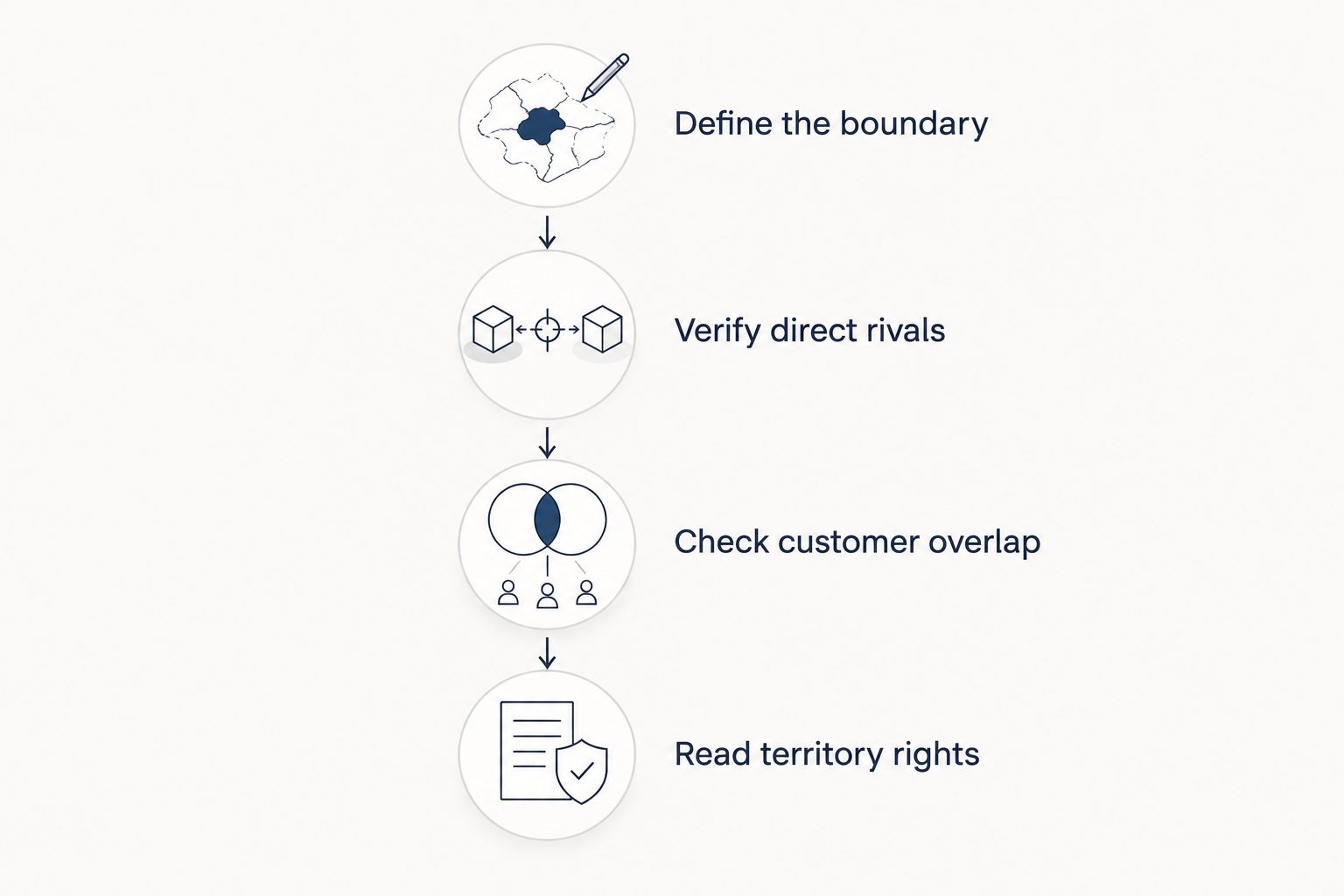
Keep the completed worksheet beside the proposed agreement. If a claim cannot be traced to a dated source or written term, leave it out of the territory's advantages.
How the territory profiles are ranked
The ranking prioritises verifiable competition, then operating fit, then additional catchment or development assumptions. It does not assign invented market shares, sales forecasts or competitor totals to Victorian towns.
Apply the criteria consistently. Compare direct rivals with direct rivals, use matching geographic boundaries, and keep observation dates visible. A 2026 shortlist should not silently mix current inspections with undated directory entries.
Before progressing, request the proposed territory map and written explanation of exclusivity. Ask what you would operate, what the franchisor provides and what remains your responsibility. National Floors should be assessed on its documented franchise offer, not on assumptions attached to the franchise model.
Explore flooring franchise ownership
Review the National Floors opportunity before discussing a proposed Victorian territory.
Which flooring franchise territory should you choose?
Choose the catchment with the clearest evidence, not the smallest visible competitor count. Start with the verified low-rival profile, then test whether its demand, operating requirements and written rights support your decision.
Do not reject a location solely because competitors already trade there. Do not accept one solely because a search returns few results. Both shortcuts avoid the question that matters: what supports a viable customer base for this particular showroom?
For your 2026 decision, keep a short written case for each finalist. State the evidence supporting it, the assumptions still being tested and the conditions that would make you stop. That gives you a decision you can explain before you commit.
FAQ
What's the best flooring franchise territory in Victoria?
The strongest shortlist candidate has verified direct competition, credible demand evidence and clear written territory rights. A low showroom count alone does not establish the best location.
Does an exclusive flooring franchise territory mean no competitors?
No. Franchise exclusivity concerns rights defined in the franchise agreement; it does not remove independent retailers or other competing businesses. Read the boundary and relevant operating terms.
How do I count flooring competitors in a territory?
Create a dated list of relevant showrooms, check their flooring categories and remove duplicate listings. Include nearby businesses outside the boundary when they serve the same prospective customers.
Is regional Victoria better than Melbourne for a flooring franchise?
Neither location type wins without a catchment-level assessment. Compare relevant rivals, demand evidence, operating requirements and contractual rights using the same method.
Should I choose an area with no flooring showroom?
Not on that fact alone. Establish whether there is sufficient customer demand and identify where residents currently shop for flooring before treating the absence of a showroom as an advantage.
What should I ask National Floors about a proposed territory?
Ask for the proposed territory map, the written exclusivity terms and an explanation of enquiry allocation. Also clarify the franchisee's responsibilities and the support specified in the offer.
How should I assess a growing Victorian suburb?
Separate existing households from approved and proposed development. Date each source and check whether its geographic scope matches the proposed territory before using it in your business case.
One last thing
A territory boundary is not a barrier around your customers. Households can compare stores beyond it, and a nearby rival does not stop competing because its address falls outside your map.
Before committing, inspect the nearest relevant showroom beyond each edge of the proposed territory. Add those businesses to your assessment. That simple check tests whether your attractive-looking territory still holds up when the boundary stops doing the thinking.